Night for Sale
The night sky is a commons — no one made it, and no one ever had to buy it. Now a handful of companies are filing to enclose it.
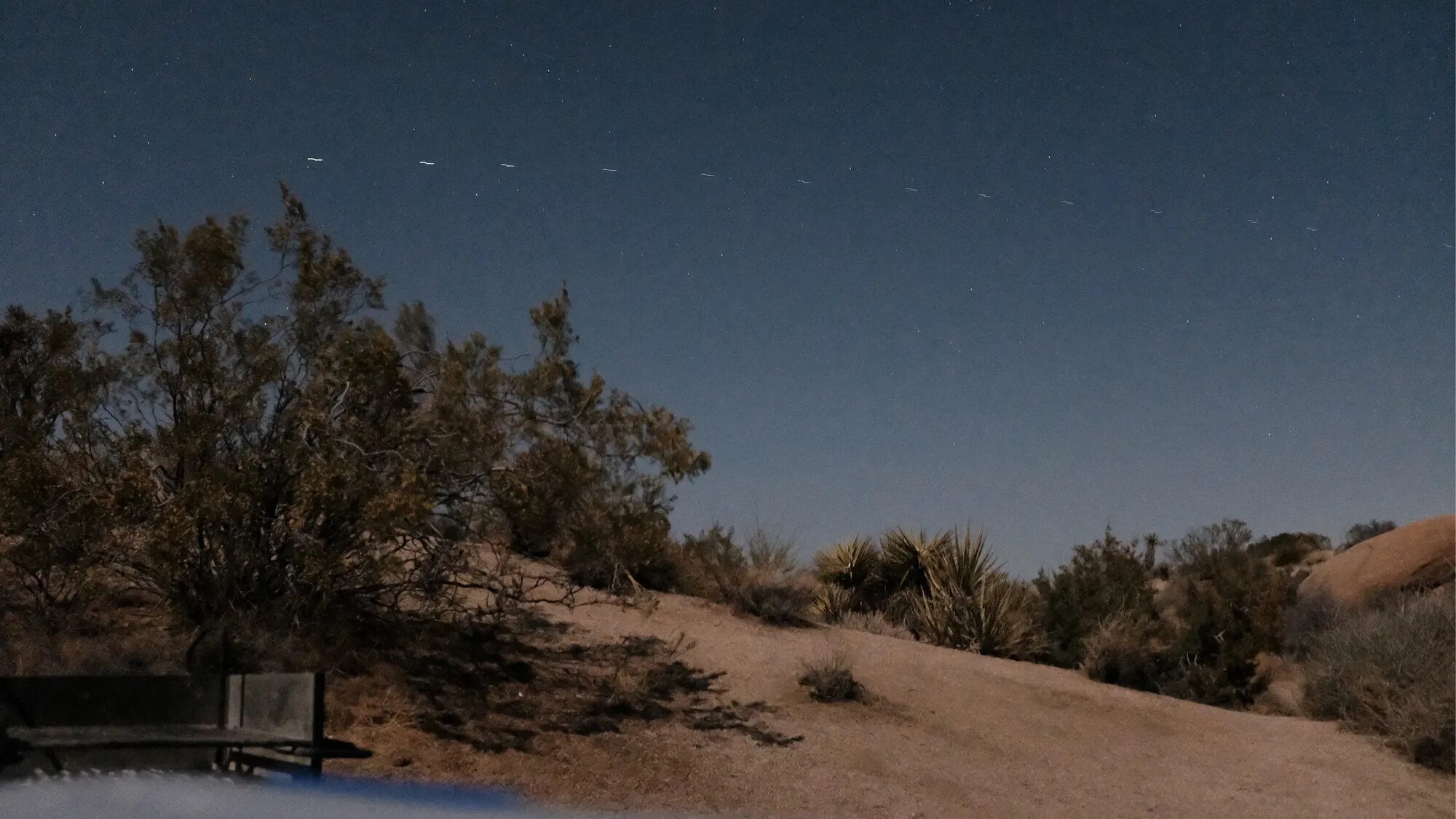
We were in Joshua Tree the first time it happened. It was late, in May of 2021, the sky still blue at the edges. A line of lights came up over the horizon — not blinking, not falling, but following a single track across the sky, a dozen or more, sliding in silence. Too orderly to be stars. Too many to be planes.
It looked like a fleet coming in, and we thought it was the end. The few people around us looked up from their stoves and got quiet. Some wondered aloud if this was it. It wasn't, but we didn't understand what we saw until we got home. It was Starlink: a batch of communication satellites that SpaceX had launched the week before. The apparition had a name, a number, and a manifest. None of it helped.
It happened again later, near Lone Pine, where the Sierra drops into the Owens Valley. By then I knew. Once you can name it, the accounting takes over. I used to love seeing a satellite at night, the single patient moving point, a made thing among the given ones. That feeling is gone. Now when I look up from the desert I see inventory. The sky is full of junk, and more is going up.
I wanted the aliens.
I grew up on Chariots of the Gods?, Erich von Däniken's book about ancient astronauts. In his version, the Nazca lines were runways, and the figures on the hillsides were portraits of visitors from the sky. The book advanced a colonial idea: that non-European peoples were too primitive to have made such marks themselves. They needed help from aliens.
That insult should have stopped me. My family is part Cherokee, and proud of it. My grandmother grew up on the reservation. Her father ran the general store. What came down to me was not primitivism but elegance: the written language, the artwork, the systems of life and government. Nothing about it felt simple or backward. I just liked the idea of alien visitors and missed the slur.
Von Däniken died early in 2026, the same year the sky finally filled with things. They are not visitors. They are constellations that deliver texts from mom and Disney+ in the middle of the desert.
How many satellites can the sky hold?
More than 1.7 million satellites have been proposed. About fourteen thousand are in orbit in July of 2026. If all the proposed systems launch, that number would rise more than a hundredfold.
Astronomers asked how many the night sky can take. About sixty thousand, they said, but only if the satellites stay dim. Each must be fainter than magnitude 7, just below what the naked eye can see. At that level the natural night brightens by one part in ten thousand. Sixty thousand invisible satellites, and the dark stays dark.
SpaceX has spent years trying to meet that target. It coats its satellites in dark mirror film that throws sunlight away from Earth. It pigments the gaps between the solar cells dark red. It paints the small parts a "low reflectivity black." It turns the solar panels edge-on as a satellite crosses into night, sacrificing about a quarter of the satellite's power. The stated goal is a satellite invisible to the naked eye once it reaches working altitude. By its own account, no operator has spent more to disappear.
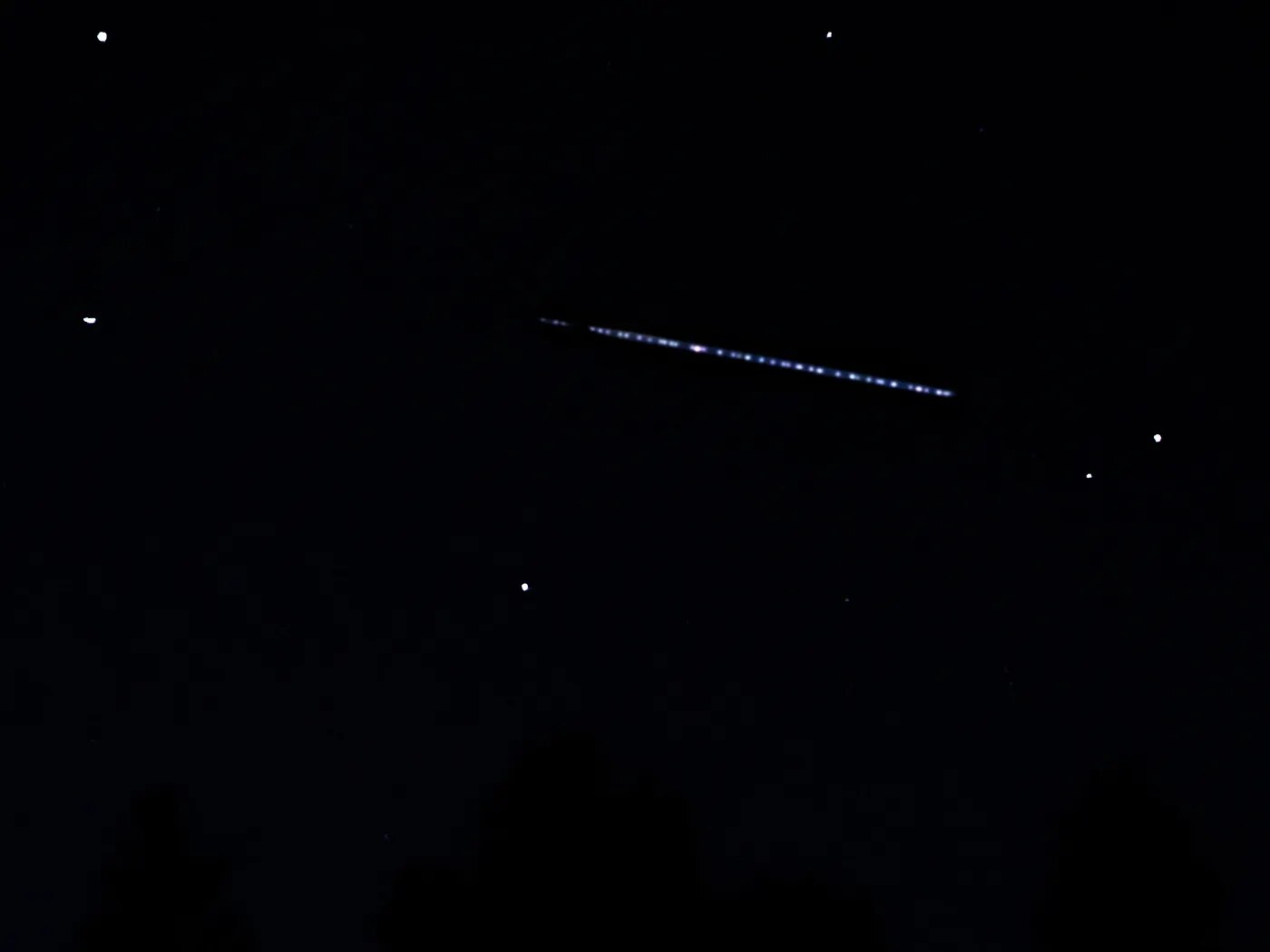
But invisible to the naked eye is not invisible. A satellite you cannot see can still ruin an astronomical image. The eye and the instrument are not the same threshold. Even below the naked-eye limit, the study says, the total has to stay under one hundred thousand. Above that, the great observatories lose more sky to satellites than they already lose to ordinary failure. The proposals are for 1.7 million.
And the trains everyone photographs, the ones we saw, are the satellites SpaceX admits it cannot hide: freshly launched and still climbing, or maneuvering, or falling back to burn. They disperse and fade within weeks. The vanishing is real, but partial. It was never going to save the night.
What do they want from the sky?
SpaceX has asked the FCC for permission to launch up to one million satellites as AI data centers in orbit. The pitch is simple: move some of the computing behind artificial intelligence off the ground and into space, where sunlight is constant and the power grid is someone else's problem.
Some of this is genuinely good. Starlink puts a signal where there was none: a village off the grid, a boat far from shore, a clinic after the storm, a front line when the towers are down. Moving computation off the ground could, in theory, spare the power and the water we now burn to cool server farms. The people building this are not cartoon villains. They are solving real problems, and some of the problems are ours. That is what makes it hard. We are not being asked to give up the sky for nothing. We are being asked to trade it for something.
Jonathan McDowell calls the proposal "a stupendous scale project" and questions whether it is environmentally better than building on Earth. Even SpaceX tells investors the technology may never become commercially viable.
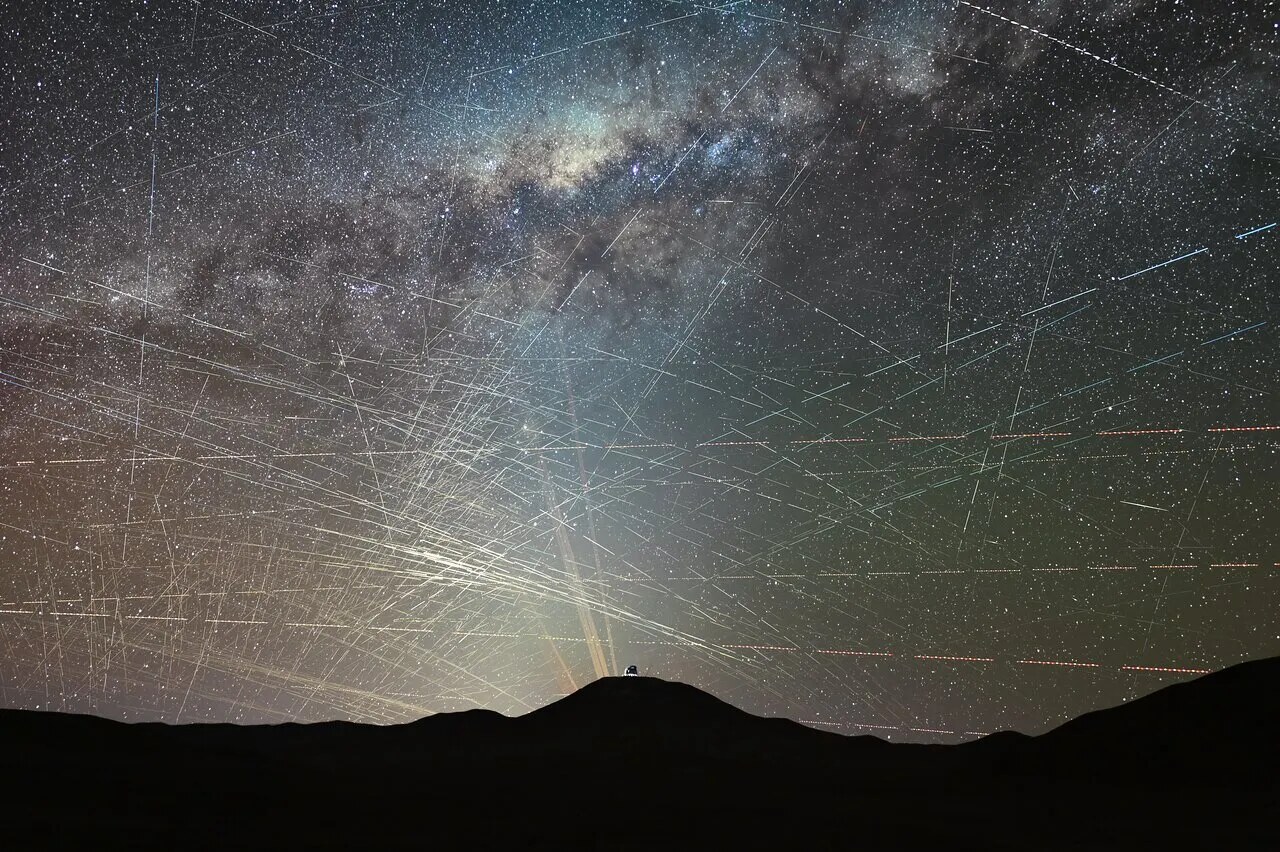
And you do not have to see a single satellite for them to take the sky. Sunlight scattering off thousands of satellites, dead spacecraft, and drifting debris adds up to a faint, even glow across the whole dome. A 2021 study estimated that this haze has already brightened the night sky by about a tenth, worldwide, enough to push the whole planet past the line astronomers drew decades ago to mark a place as light-polluted. City lights erase the stars from below. This erases them from within. Even in the darkest desert, the faintest stars are dissolving into a background we manufactured. Invisible is not the same as absent. The machines are still there. The sky has still been occupied.
It is not the ending anyone pictured. Arthur C. Clarke pictured it once. In "The Nine Billion Names of God," a computer finishes the task the universe was supposedly made for, and the world does not end in fire. Two men walk down a mountain, look up, and read the last line of the story: overhead, without any fuss, the stars are going out. Ours are not going out exactly; they are drowning, which is slower and harder to see. But it feels the same. That is how the sky goes. Not an alien fleet, not a falling sky, but quietly, one filing at a time, brightened by a tenth, sold by the acre, until the desert night is bright, like a city's.
This loss is not a law of physics. It is not the price of progress. It is a decision by a handful of companies about a thing that belongs to everyone. The night sky is a commons for the plainest reason: no one made it, and no one ever had to buy it. The rest of us are not asked what it is worth. We are not allowed to charge for what is taken.
One of those companies is Reflect Orbital, and its product is daylight. Sunlight, it points out, is the most abundant thing in the solar system, and almost all of it misses us. Their proposal is to catch a little of the excess with mirrors and aim it back down, onto the night side of the planet, on demand, for a fee. The first mirror is eighteen meters on a side; the plan, by 2035, is more than fifty thousand of them, able to hold a five-kilometer circle of ground at full daylight for hours. They've raised their millions, signed an Air Force contract, and filed a demonstration satellite, Eärendil-1, for launch. Night, in this business model, is not a condition of the planet. It is an unserved market.
You'd think switching off the dark over a stretch of the Earth is the kind of thing someone has to approve. It is. The FCC licenses commercial satellites and must find that a project serves "the public interest." But the agency was built to regulate radio interference and orbital debris, not light poured onto the ground. It treats satellites as "extraterritorial." Because the hardware is in space, it falls outside ordinary environmental review — even when the project is designed to change conditions on the ground. The light lands; the paperwork says it doesn't. That isn't an oversight but a policy. In 2020 the White House declared that outer space is "a legally and physically unique domain" and that the United States "does not view it as a global commons." The answer to who owns the night sky is written down after all: officially, no one. In practice, it belongs to whoever files first.
And the first to file is the one that matters, because the first enclosure is never the whole enclosure. It is the proof that enclosure is allowed. Approve one demonstration mirror and you have not approved a mirror — you have established that the sky can be licensed, that its light is "extraterritorial," and that no one needs to be asked. Every proposal after it begins from a sky where the machines already belong. This is why the astronomers are fighting a single demo as if the whole night were at stake in it. It is.
We have answered this question before, and better. When the first skyscrapers threatened to wall the light out of the streets of New York, the city looked up and wrote the sky into law: the 1916 zoning code made buildings step back as they rose — the "wedding cake" silhouette you still see on the older towers — so that light and air kept reaching the ground. That skyline is the fossil of a decision — proof that a public claim on the sky can be written into law and made to hold. A century later, the federal government is treating the night sky as something companies may use first and explain later. A zoning board 110 years ago respected the sky more than our government today.
The language rises to meet the ambition, then immediately ducks into paperwork. Reflect Orbital named its first mirror Eärendil, after Tolkien's mariner who carries a recovered light into the sky and becomes a star of hope, a guide for people lost in darkness. In the filings, that hopeful star is recast as a product "directed to the approved end user" within a "defined service area," with "minimal sky glow." Myth and bureaucracy do the same work from opposite ends. One makes the machine sound noble; the other makes it sound harmless. Between them, the fencing-off of the last commons begins to sound like a courtesy. Astronomers have petitioned to deny Eärendil-1 outright.
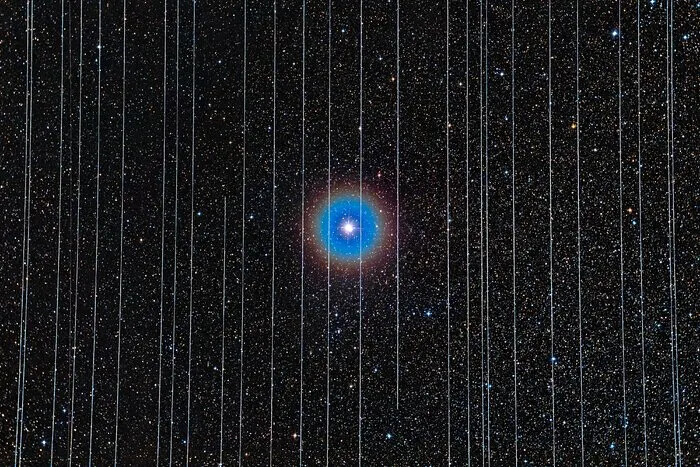
An astronomer notices something stranger than the streaks. Olivier Hainaut, who models this for the European Southern Observatory, put it plainly: the satellites are brighter than the galaxies behind them. A single Starlink unit, catching the sun at dusk, outshines light that set out toward us before the Earth was born.
Sit with what that inverts. For the whole of human history, brightness in the sky meant grandeur — the near stars, the planets, the Moon; and behind them the faint uncountable rest, where faintness meant distance, and distance meant age, and age meant awe. A dim smudge was a galaxy, a hundred billion suns so far off their whole light reaches us as a whisper. Now the brightest new points overhead are the smallest, nearest, most disposable objects in the scene: a mass-produced box the size of a table, stamped out by the thousand, built to work five years and then burn up as scrap. It has no grandeur of its own, and it outshines the galaxy behind it. Brightness used to point toward age, distance, and scale. Now it often points toward ownership, proximity, and reflected sunlight.
You can see it in the photograph of Albireo, the double star behind its fence of trails: blue-and-gold light centuries old, caged by Starlink built last year. The night sky was the great commons of the immaterial — old light, free light, light that belonged to no one and had crossed unimaginable distance to reach an eye. We are drowning it in the material: near light, bought light, bounced off metal that will be garbage before the starlight it blotted out has finished passing. And we are about to be told that this is us ascending.
This is an old move: a story laid over the taking, large enough that you look at the story instead. I grew up on one such story, a paperback about ancient astronauts built on the assumption that ancient peoples couldn't have drawn their own lines. Today we have another. Filling the sky with machines becomes our graduation to the stars. Von Däniken took the Nazca's genius. We take the night.
Ask what the project actually does. It changes the sky. The one thing nearly every person and creature who ever lived has had overhead becomes an industrial medium, a manmade thing that moves and blinks and sells.
The compute is the excuse. The changed sky is the deed.
For as long as there have been people, the night sky was one thing that we didn't make. You could stand in the desert and look up at something older than every human work, indifferent to us, of incalculable value. Part of what it is to be a person is to see, nightly, the plain evidence that the world is not all our own doing. Fill that sky with satellites and the encounter inverts. The lights move now; they cross, they blink, they slide in formation. Look up from a dark place and you no longer meet the ancient sky — you watch traffic, cars on a far highway, a drone show someone booked and paid for. Every point of light a thing we made, running an errand we assigned, for a company you could name.
A species that can only ever see its own works is a smaller species. We were made, in part, by looking up at what we did not make — it is where wonder came from, and humility, and most of our gods. Pave that over and we lose more than the stars: we lose a way of being human that needed the stars in order to happen. And it isn't only us who read that sky. Birds migrate by the stars; dung beetles steer by the Milky Way; coral and turtles and the creatures of the tide keep time by moonlight and the dark. Whatever this costs us in wonder, it costs them in navigation. And here is the cruelty: an astronomer can subtract the streaks — filter them out, aim where the satellites aren't. A bird cannot. A navigator reading the horizon at dusk cannot. A person looking up cannot. The lived sky happens in real time, and it has no undo; what the instruments recover, the eye and the wing and the tide simply lose. The same desert where people once made marks for the sky now lies beneath a sky made entirely of marks, none of them ours to read.
The next time the lights come over the mountains, we will know what they are, and the knowing will be the loss: a name for every point, an owner, a bill, and no reason left to pull off the road. I keep going back to that first night in Joshua Tree and the real fear that this was the end of the world. The formation crossed in silence and left us there in the dark, not yet knowing it was for sale.