The One You Can Point At
Everything else that tracks you is in a data center or a squad car. This one is bolted to a pole.
A man who goes by NoMark spent an hour in the bushes across from a Taco Bell in Minneapolis, a few feet behind a pole, before he could make himself climb it. He told The Guardian he was so nervous the adrenaline felt paralyzing. When the road finally was empty he went up, taped over the lens, cut the wires that powered the thing, stopped the recording he was making for seven hundred thousand followers, and ran. It took a few minutes. He has done it more than a dozen times by now.
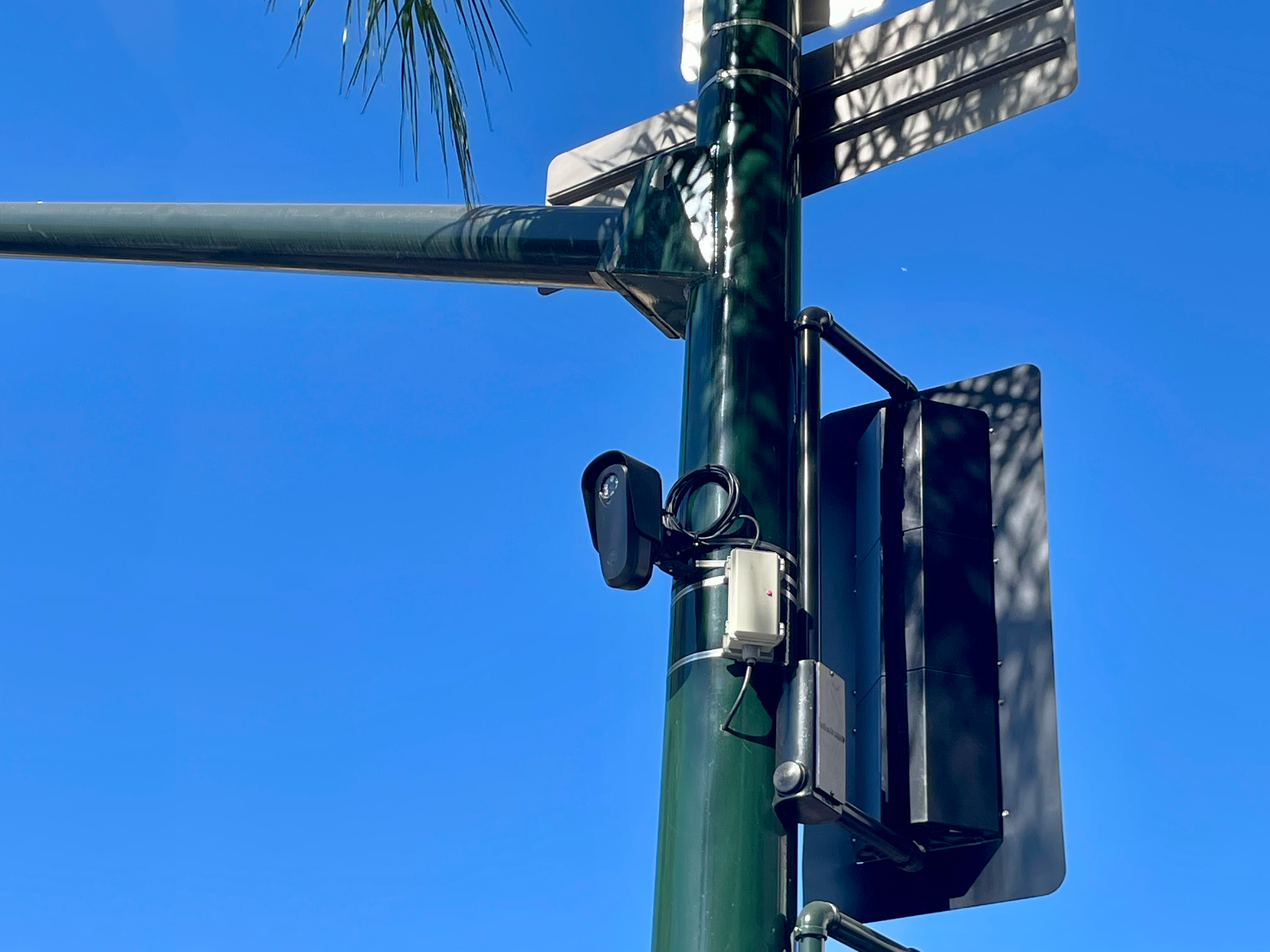
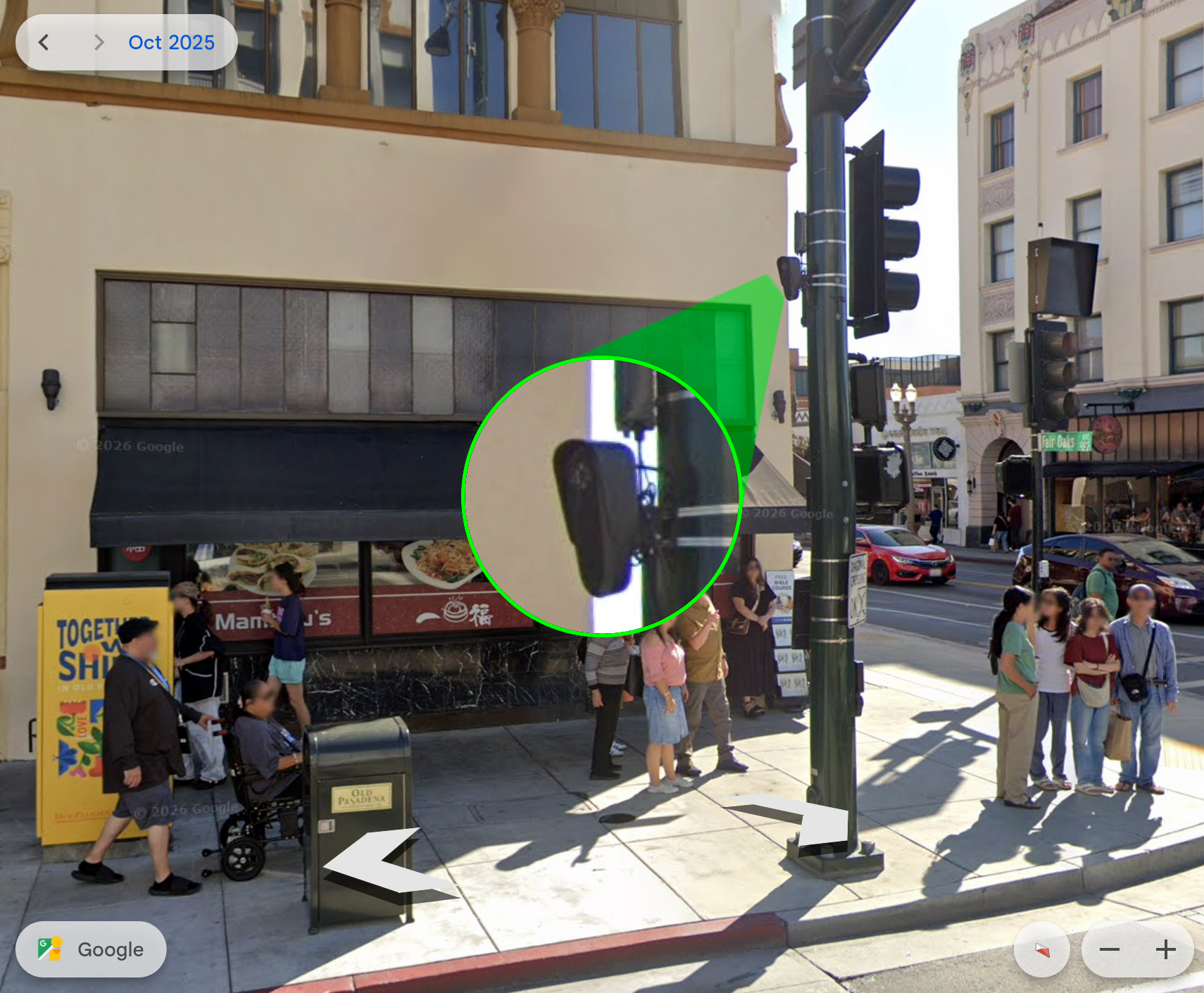
It's hard to stop things that watch you. These cameras send your location to remote servers. A face-search app is in the officer's pocket. A cell-site simulator is a box in a car. The Flock camera is a black box bolted to a pole beside the road, usually beneath a distinctive black solar panel, sometimes wired straight into the traffic signal. It is the only part of the apparatus you can touch. Or hit with a bat. I drive past one every week.
Flock Safety is based in Georgia, valued at $8.4 billion, and says its cameras scan billions of license plates each month across about six thousand communities in most every state. The cameras photograph passing vehicles and compare the plates against databases. The company says its readers are "not mass surveillance tools" and "cannot track vehicles, much less individual people." Yet in July 2026, 404 Media reported that police had used Flock's newer video cameras hundreds of times to search for people by typing plain-language descriptions: a man in a gray shirt, a tall man in a baseball cap, a woman in Ugg boots.
The network
In Norfolk, Virginia, where police had installed 172 license-plate readers, Councilman Tommy Smigiel asked Chief Mark Talbot at a council work session in May 2023 how quickly a stolen car would appear in the Flock system after its owner called 911. Talbot answered, "Very," adding that officers could follow the car even without knowing its license plate number. A camera identifies a car. The network reconstructs its journey.
The network depends on density. Flock sells subscriptions rather than cameras, making large deployments affordable. Then it grows the network from two directions. Homeowners associations, schools, and businesses install cameras first. When police departments arrive later, Flock can point to an existing network of private cameras whose owners may choose to share their reads with law enforcement. Dave Maass, director of investigations at the Electronic Frontier Foundation, says that is how the company "wheedled its way into communities."
The objection
People have noticed. The Guardian counted at least thirty-three acts of deliberate damage or obstruction against Flock cameras across twenty-three states. In Oakland, someone has been paint-bombing them. A Reddit user published a 3D-printable shroud that blocks the lens without damaging the camera, arguing that obstruction is not vandalism. Another camera was torn down with a note left behind: "hahaha get wrecked ya surveilling fucks."
Some of those protests have ended in arrests. Jeffrey Sovern faces charges in Suffolk, Virginia, for allegedly damaging more than a dozen cameras. On his legal-defense page, he wrote that he would accept being remembered as a catalyst. Jevon Martinez was arrested in Rio Rancho, New Mexico, after thirteen cameras were damaged, and near one of them someone left a sign reading, "You're welcome, the Republic of New Mexico."
Flock's response reveals the economics of the network. In mid-July the company published instructions for agencies responding to damaged cameras. "We've planned for it," the notice says, adding that protection plans are available for purchase. A cut wire is not a wound. It is a cost the subscription has already anticipated.
The objection itself is anticipated as well. In June and July, state fusion centers (the hubs that pass intelligence among federal, state, and local agencies) circulated bulletins about opposition to the cameras. One bulletin in Florida acknowledged that some advocates support peaceful, lawful protest while others support destroying the cameras, then treated them as a single movement. A Wisconsin digest instructed departments to increase patrols around plate readers during planned protests, review earlier cases of damage, and report vandalism, disruption, and sabotage to the fusion center. It also told departments to report unusual inquiries about the cameras.
What the audit measures
Pasadena's independent police auditor, Teresa Magula, reported to the Community Police Oversight Commission that about 70% of the Police Department's Flock searches were for specific license plates tied to an active investigation. That is what targeted use looks like, and it should be said plainly because it is the strongest argument for the system. Seventy percent of the time, the officer already knows which car. The question is narrow, particular, and tied to a named case. There is a civilian commission, an independent auditor, and a published finding. Yet even this audit points beyond the search itself. The remaining queries used color, make, or vehicle type rather than a known plate number. And the city disabled NCRIC access after questions about indirect sharing through a fusion-center network.
Still, Denver City Councilmember Sarah Parady argued that effectiveness was beside the point. "Of course it works," she said. "That's not the point. If we put a tracker on every human being in Denver, we would solve every crime, and we would get a whole lot of other bad, unintended consequences of that."
The network behaves like an immune system. It distributes remembered signatures throughout the body and checks every encounter against them. The pathology begins when the system can no longer distinguish the threat from the body it exists to defend.
The comparison fails in one place. An immune system serves one body, and every cell shares its fate; there is no arrangement where the spleen profits and the liver pays. This network serves many bodies instead: a police department, a sheriff's department, a homeowners association, a school, a shopping mall, whatever federal agency is invited in, and a company with shareholders. They do not share a common fate.
A body also spends enormous effort learning what not to attack. Cells that mistake the body for an invader are destroyed before they are ever released. This system has no equivalent. Instead, it has a box where an officer types a reason and, in Pasadena, an auditor who reads it afterward.
The audit has the same blind spot. It audits the asking, not the seeing. It begins after the collection is complete. The narrow question exists only because the broad record already exists. It can tell you whether the search was justified. It cannot tell you whether the database should have existed in the first place. The searches may have been justified. The system was reading every passing vehicle, all day, every day.
Then there is where the poles are. In March, Councilmember Justin Jones asked why so many of the city's cameras stand in District 3, in northwest Pasadena. Jones is an elected official, not an activist, and he was asking about geography rather than misuse. But geography is the whole question. Restrictive covenants kept Black families to the north and west sides of the city. Later, the 210 and its feeder roads were cut through those same neighborhoods. Signs along the interchange still name the churches and cemeteries that were moved to build them. The cameras are concentrated there now. If every search is proper, one neighborhood still accumulates a denser record than the rest. The audit begins with the search. The unequal record began long before it.
Not all of it is wire cutters. DeFlock runs a crowdsourced map of more than 107,000 plate readers and will route you around them. More than eighty cities have cancelled, declined to renew, or switched off their contracts, including Austin and Denver. Last year, Flock's chief executive called DeFlock a "terroristic organization." This July, after the remark resurfaced, he apologized, attributing the group's growth to his own company's "inadequate response to the questions and concerns that people have."
Twenty-eight houses
At the end of 2025, a few weeks before Christmas, a sheriff’s deputy rolled down her window to talk to me on my street in Altadena. My house had burned in January. She asked whether I knew of any cameras on the block, anything that might help them do their job better. She said something about eyes on the street. She said patrols were fewer.
She had already tried the house across the street, where the cameras are, and nobody was home to ask. Twenty-eight houses on my block. Seven are still standing. His is one of the seven, which is not the same as being able to live in it. His things are still inside. He is testing for lead and arguing with his insurance company about what counts as clean, and until that is settled, he stays away. Before he left he mounted cameras facing his driveway and the street, and put no-trespassing signs beneath them. They are still recording.
Twenty-one houses are gone. The eyes on the street belong to a camera on a house nobody sleeps in.
I did not know what Flock was then. Later I found the map, and after that I could see them: on poles at intersections I had been driving past for years.
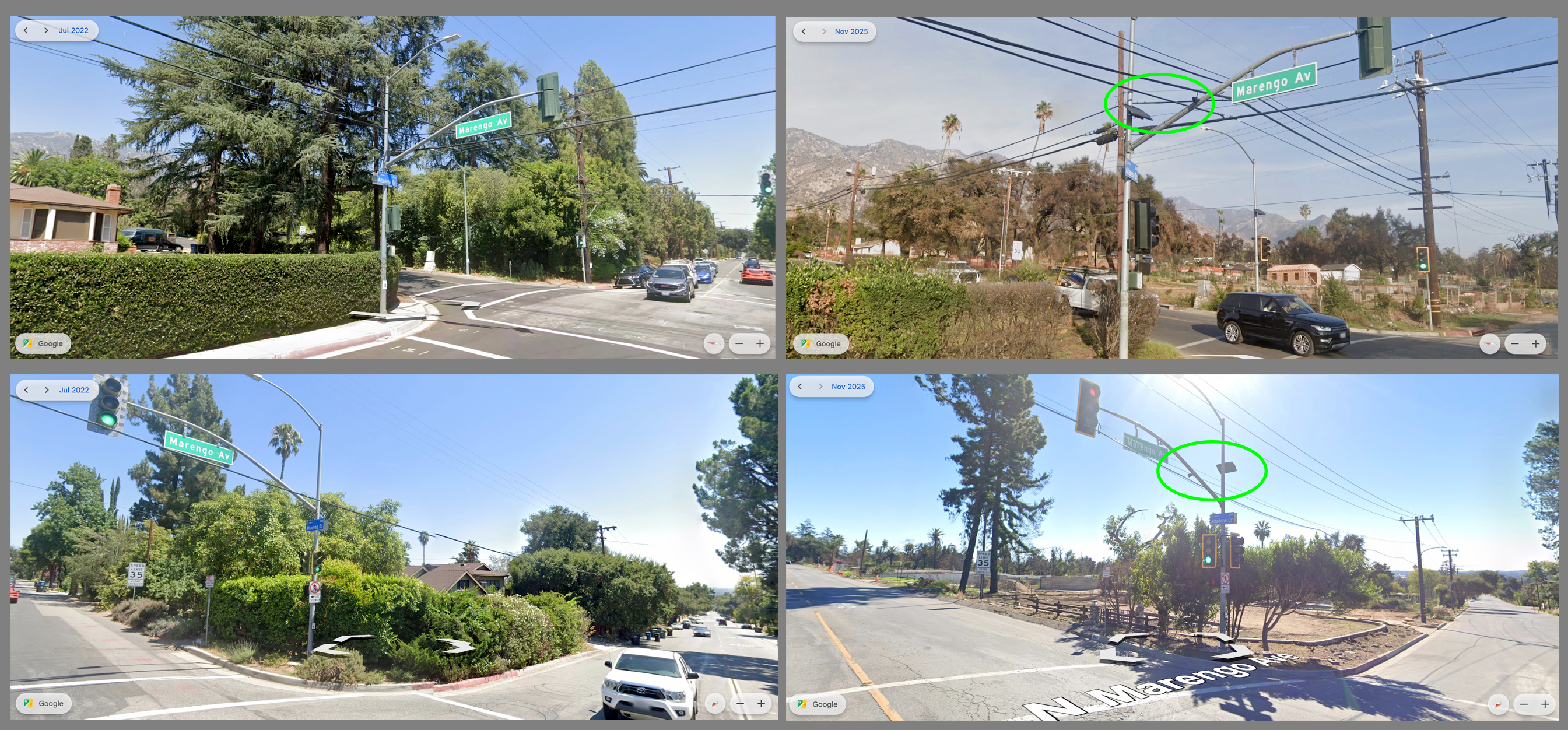
These cameras watch over Altadena Drive and Marengo Avenue. I pass them most weeks. Rebuilding started last month, seventeen months after the fire, and the lot is still just a hole in the ground. On the county’s Eaton Fire Damage Inspection Status map, every destroyed structure is a red icon. Around that corner, the red runs to the edge of the frame in every direction. Houses that came through undamaged are marked in gray. Near Marengo, you can count them.
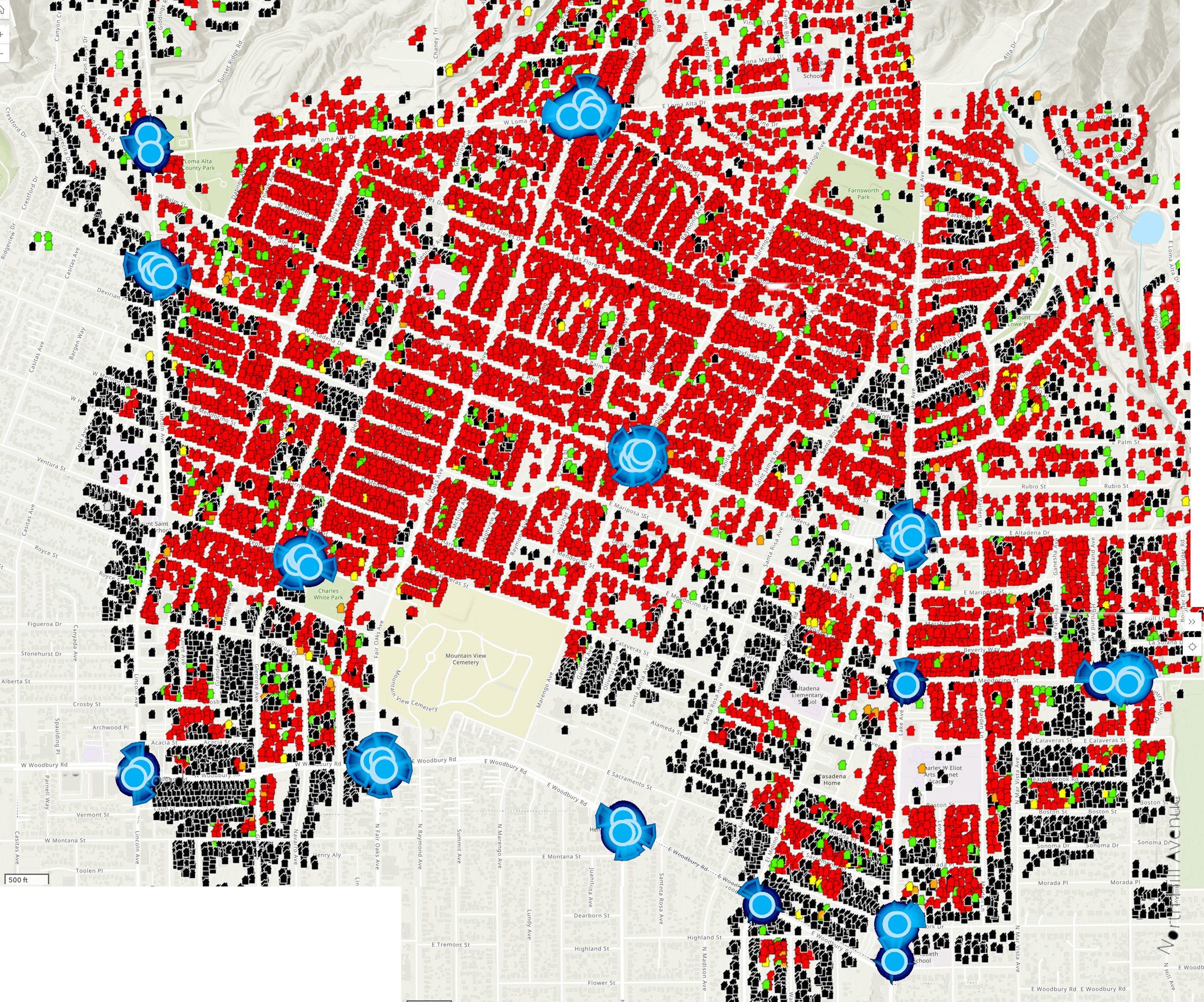
Then I put the camera locations on top of the fire map. That one stands in the middle of the burn. Most of the others trace its edge along Lincoln and Woodbury and Lake and Hill. You pass one going in and another coming out.
The cameras came after the fire. The sheriff's department installed them that spring to deter looting, after residential burglaries in the burn area had increased by about four hundred and fifty percent. By the end of the year a deputy was asking me who else on the block had one. In May, a commander told the county’s oversight commission that the Flock cameras in Altadena had been switched off, and that he did not know how long they had been out of commission.
The one at Marengo is still on its pole. Nothing on it lights up. From the road there is no way to tell if it's working or not.
Altadena is unincorporated. There is no city council to ask Jones's question. The sheriff's station audited its own cameras for ninety days and later announced on Facebook that their settings keep the data inside California.
There is a website where you can type in your license plate and see which agencies have searched for it. It runs on audit logs departments have released under public records law. I typed in mine and nothing came back, which means that nobody looked for me, or that the department patrolling my street has never released its logs. It cannot tell me how many times I have been read.
The poles have locations. The records do not.
Sources
The vigilantes, Flock's scale, and its denials. Sanya Mansoor, "Inside the growing vigilante movement to knock out Flock surveillance cameras," The Guardian, July 25, 2026 — NoMark; the count of at least thirty-three acts of damage or obstruction across twenty-three states; the Oakland paint-bombing; the 3D-printed lens shroud; the note left on a downed camera; Jeffrey Sovern in Suffolk, Virginia, and Jevon Martinez in Rio Rancho, New Mexico; Flock's "We've planned for it" notice and its protection plans; the $8.4 billion valuation and the scan figures; and the company's February 2026 statement that its readers are "not mass surveillance tools" and "cannot track vehicles, much less individual people." Chief executive Garrett Langley's apology is from Forbes, July 17, 2026.
Searching for people by description. Joseph Cox, "How Cops Use Flock to Track People, Not Cars," 404 Media, July 16, 2026.
Norfolk. "Norfolk installed license plate reading cameras that can follow a car throughout the city," The Virginian-Pilot, May 2023, republished by Government Technology — Councilman Tommy Smigiel's question and Chief Mark Talbot's answer at a City Council work session.
How the network grows. Dave Maass, Electronic Frontier Foundation, in "The police's terrifying new cameras," Tunnel Vision.
The fusion centers. Dan Boguslaw, "Exclusive: Government Spy Hubs Are Surveilling Anti-Flock Camera Activists," Deeper States, July 21, 2026, and the documents published with it: Central Florida Intelligence Exchange bulletin 26-06-19, June 25, 2026, and a Wisconsin State Wide Intelligence Center product distributed July 3, 2026, which directs officers to report vandalism, disruption, and sabotage of plate readers, and unusual inquiries about them, to their fusion centers.
Pasadena. "Independent Audit Finds Pasadena Police's Flock Camera Program Complies With State Law, Department Policy," Pasadena Now, July 2026 — independent police auditor Teresa Magula's report to the Community Police Oversight Commission, and the disabling of NCRIC access. Councilmember Justin Jones on camera concentration in District 3 dates from March 2026.
Denver. Councilmember Sarah Parady, in Tunnel Vision.
Covenants and the freeways. "Racial Segregation in Pasadena: The Role of Freeway Construction," UCLA Luskin, 2025, published on the City of Pasadena's website.
DeFlock. Camera count as displayed on DeFlock's own map in early July 2026, recorded in the Wisconsin bulletin above; contract cancellations per deflock.org.
Altadena. "AI cameras placed in Altadena to deter burglaries, thefts," NBC Los Angeles, April 30, 2025, for the post-fire deployment. The burglary increase is reported by ABC7 ("LASD increases security in Altadena area after burglaries spike by 450% in aftermath of Eaton Fire," April 30, 2025) and the Los Angeles Times ("Soaring burglaries in post-fire Altadena rattle residents," April 28, 2025). Commander Ernest Bille's statement that the county-contracted Flock cameras in the area are deactivated comes from the Sheriff Civilian Oversight Commission's public forum on automated license plate readers, May 6, 2026, as reported by LAist, May 7, 2026; see also Gab Apo, "County Oversight Panel Asks Altadena, Pasadena Residents to Weigh In on License Plate Surveillance," Pasadena Now, May 6, 2026. The ninety-day audit and the California-only setting are from "Public Flock Statement for Altadena Residents," Altadena Sheriff's Station.
The plate lookup. haveibeenflocked.com, which searches Flock audit logs released by agencies under public records law.
Images. Flock camera on a signal pole at Fair Oaks Avenue, Old Pasadena, photograph by the author, July 2026; the camera was spotted by Rebecca Baron, whose How Little We Know of Our Neighbours (2005) is about Britain's Mass-Observation movement, candid photography, and surveillance. Fair Oaks Avenue, Old Pasadena: Google Street View, October 2025. Camera locations from DeFlock's crowdsourced map over Los Angeles County's Eaton Fire Damage Inspection Status layer, imagery flown January 18, 2025 by LARIAC. Altadena Drive and Marengo Avenue: Google Street View, July 2022 and November 2025.