When Faster Isn't Better: How Displays Cheat Time
An computerized experiment from 1968, a 2013 computer that could almost run it, and the breakout box that finally let me finish what Mayzner asked for. This is the archive for my talk at Hackaday Supercon 2026: the experiment it is built on, the box that runs it, and the full transcript of the talk.
The experiment
Mayzner found the sweet spot in 1968. Clap once: that impulse lasts about a tenth of a second. If a whole word arrives faster than that clap, you see all five letters at once. Slower than three claps and they step across like a sign. In between, the letters that arrived first get erased by the ones that came after, with peak erasure around 200 ms, about 40 ms a letter. These are measurements, not a law. They slide with brightness and contrast.
In 2013 I rebuilt that experiment for his new iMac, a machine a thousand times faster than the one he had in 1968. The number keys set the time per letter in steps of 10 ms. And it worked. Sometimes. "This is very strange," he wrote. It was not strange, it was a bug, and it took me years to find because it was not in my code. It was in the glass. A screen refreshes 60 times a second: ask it for 5 ms of light and you get 16.7, a whole frame, starting whenever the next frame happens to begin. Letters straddle frame edges, two land on the same frame, some never clear the window at all.
Mayzner's display had no frame rate at all: a DEC PDP-7 with 8K words of core, driving a Fairchild CRT whose phosphor went dark in microseconds, clocked by a crystal ticking 20,000 times a second. It could hold a letter for any multiple of 50 microseconds, switching it on and off two thousand times inside a single clap. My projector gets six goes. The iMac is a brilliant assistant who will absolutely get to it, right after forty other things, and then hands the result to a shutter that opens 60 times a second. It can count five milliseconds. It cannot promise five milliseconds of light. Precision is not speed. An ESP32, a 555 timer, a Nipkow disk: every one is a worse computer than that iMac, and every one of them can do it.
The hardware
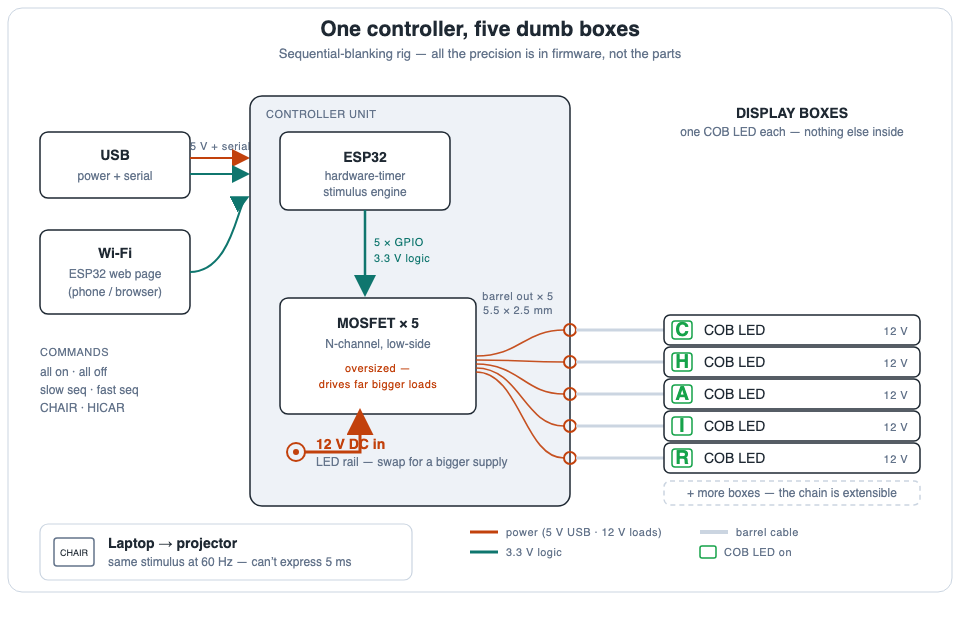
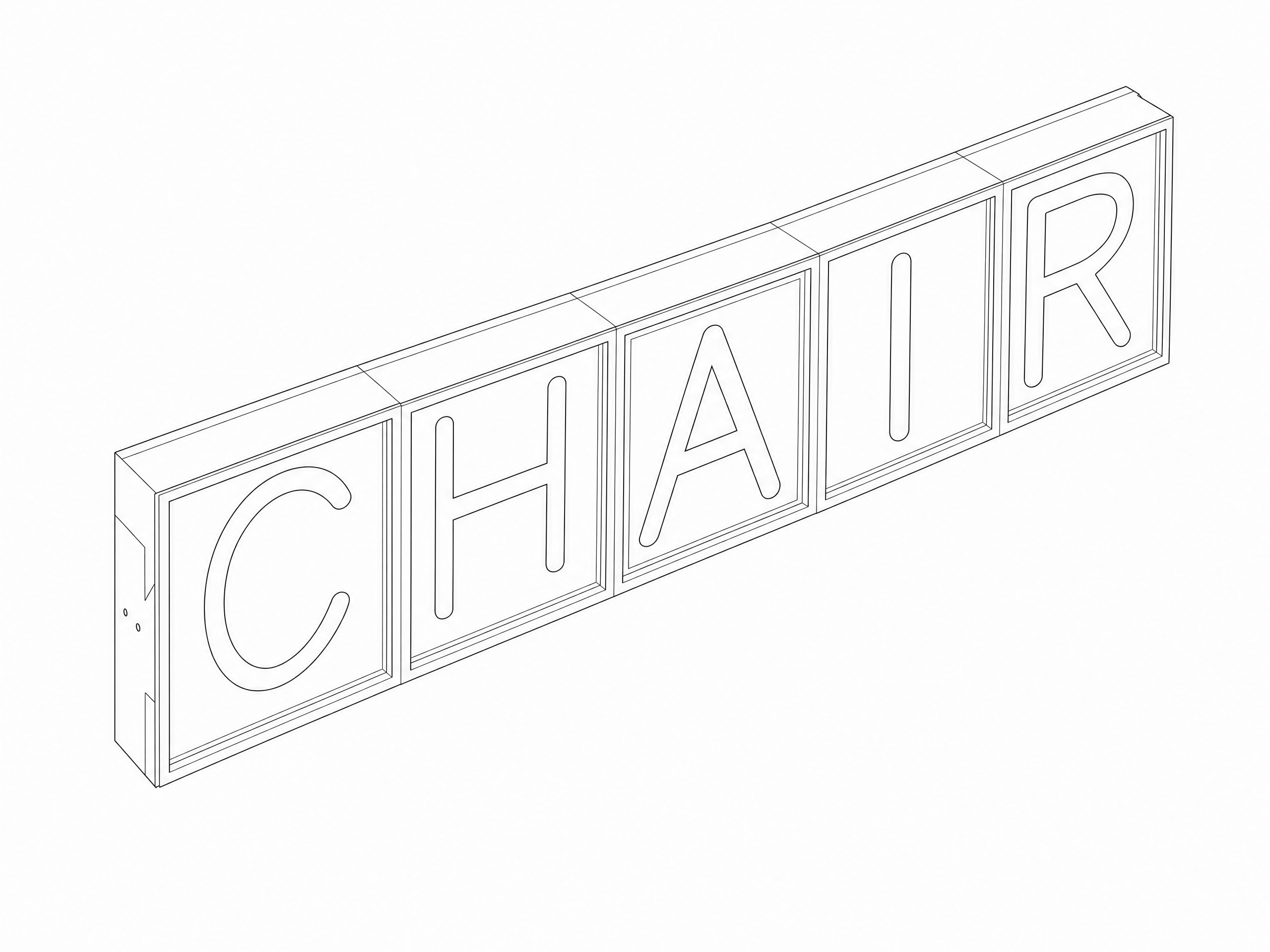
Each display is a single COB (chip-on-board) LED and nothing else — a 5.5 × 2.5 mm barrel jack and a cable, no electronics in the box at all. Five of them, one per letter of CHAIR, and the chain is extensible.
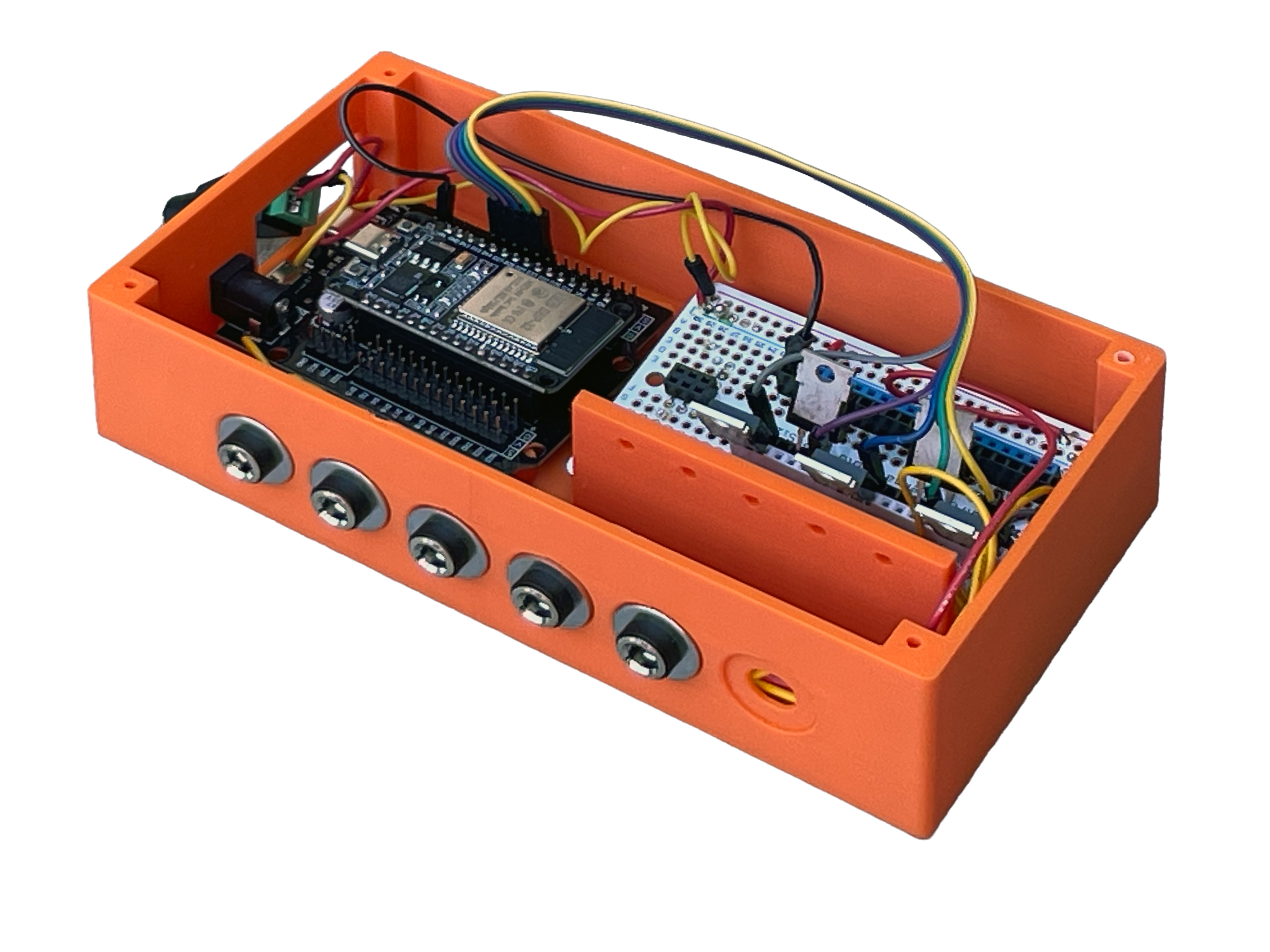
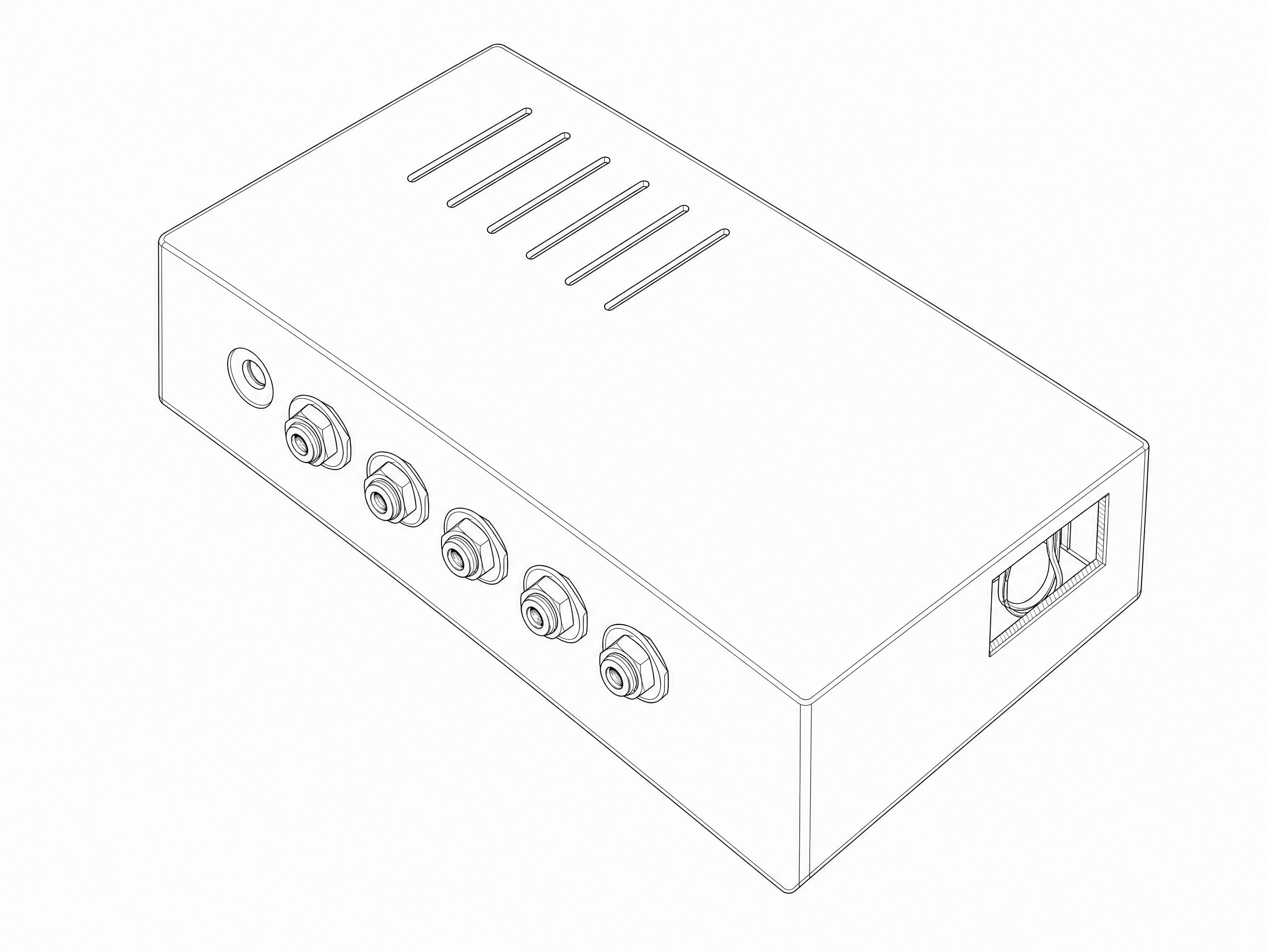
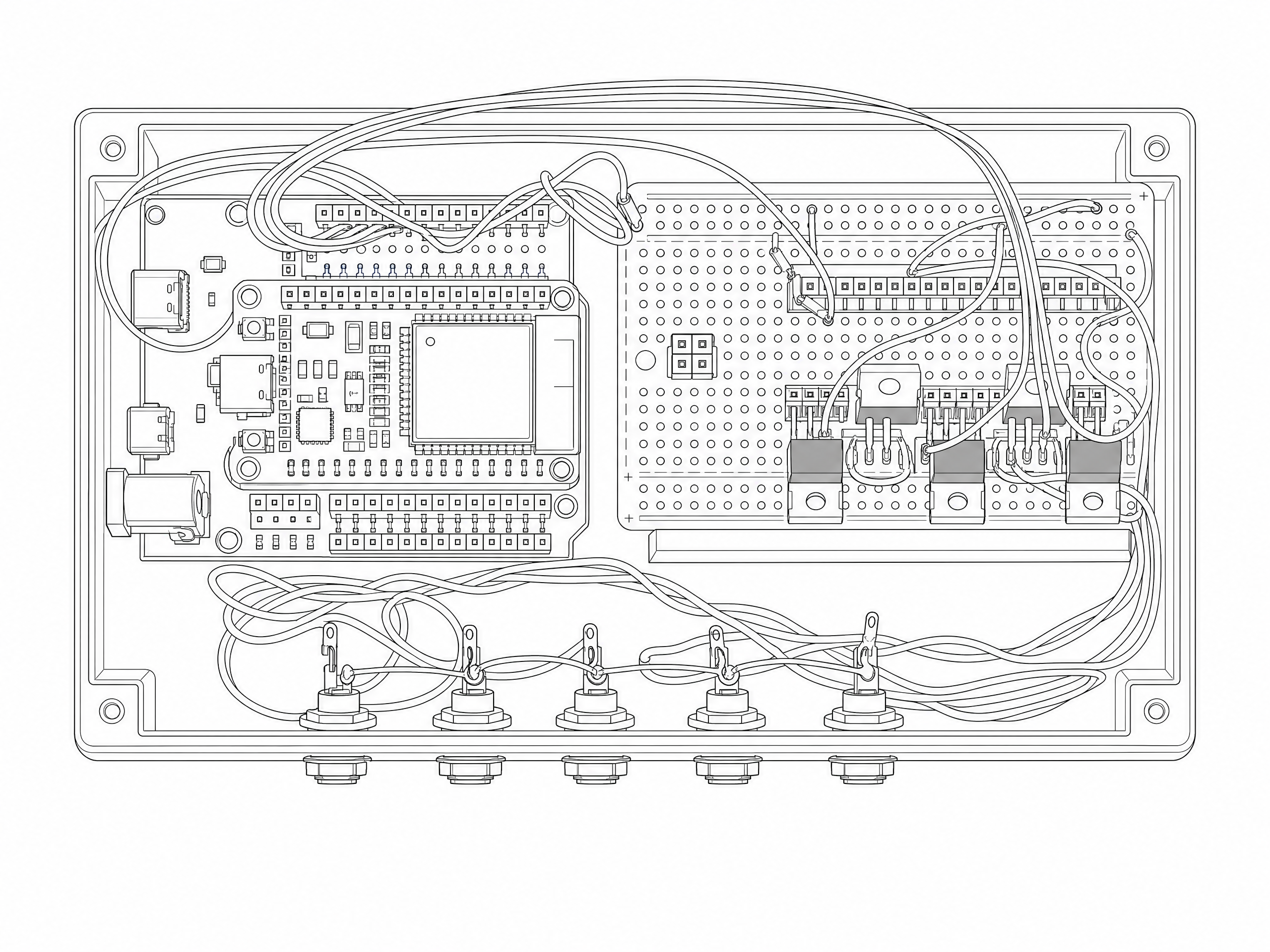
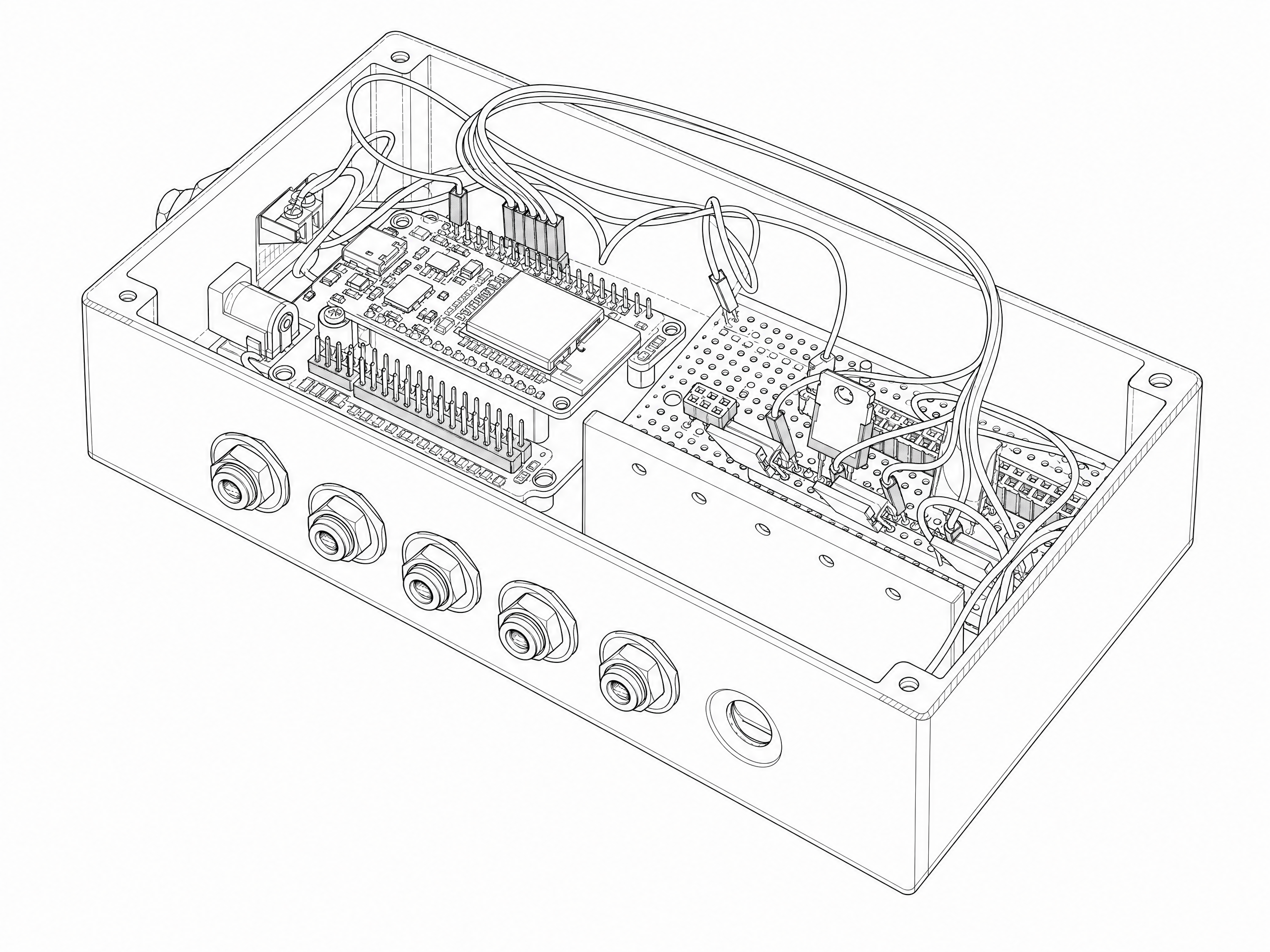
They plug into a controller unit: 12 V DC in, an ESP32, and a breakout board carrying one oversized N-channel MOSFET per output. The ESP32's 3.3 V pins switch the MOSFETs, and the MOSFETs switch 12 V to the boxes. The ESP32 itself is powered over USB, so the 12 V is a separate rail that only ever reaches the switched LED outputs. The parts are over-specced on purpose. It belongs on a PCB and isn't yet; that is the next skill to pick up.
All the precision lives in the firmware. A hardware timer holds each output on for an exact span — 40 ms, or 5 — then off, with a configurable blanking interval between letters, and no frame rate to round to. You drive it over USB from the Arduino IDE, or from a small web page the ESP32 serves to your phone. The honest gap, and the first thing a Hackaday room asks about: nothing closes the loop yet. The box commands the timing exactly; it does not yet measure what the light actually did.
The mystery
There is one result I could not picture until the box existed. Take a grid of a single letter and light it in groups, 20 ms on and 80 ms dark. Show two groups and the first pair vanishes. Now add more light, a third group lit last, and the first pair comes back. Adding light made something reappear. Mayzner called it disinhibition, and nobody fully knows why; Hartline and Ratliff saw the same shape in the eye of the horseshoe crab. I am happy to let it stay strange.
If the letters disappear, is the information gone too? Irwin Pollack asked that at Michigan in 1972 with a forced choice: rows of short lines instead of letters, one of them tilted. Did you see the line? No. Which line was different? That one, picked as accurately as when it was plainly visible, sometimes more so. Those are not the same question, and the visual system answers them differently. The information got in. The experience did not.
So: the same light twice, two different words. That is a problem of perception and a problem of instrumentation, and they are not the same problem. Something we called an improvement quietly changed which experiments we could still run, and it took an $80 analog scope and a box of LEDs to get one of them back. Which leaves the question I cannot answer, and neither can anyone else: how much of what reaches you do you ever get to see?
I wrote to Mayzner to ask about the past. He gave me an experiment to finish. Here is what he wrote in June 2013, about the half-working iMac version:
"Clearly, you have been able to produce what we hoped would appear. At our next session we will have much to discuss where we go next."
He is 99 now, still living in Florida. The slides, the interactive step-by-step versions of the experiments, and more are at hackaday.cairn.com.
The talk
Hackaday Supercon 2026. Transcript from the video. Lightly cleaned: fragmented segments merged into paragraphs, two repetition artifacts removed, names corrected. Spoken content is otherwise faithful.
Introduction (Allie Katz)
Our next speaker builds instruments that make invisible things visible. Doug teaches at CalArts and UCLA with courses like Fuzzbox Physics, which treats distortion as a material rather than a defect, and Unconventional Computing. With Rebecca Baron, Doug makes essay films about the artifacts machines leave behind. Their Lossless series was the first digital work acquired by the George Eastman Museum. Last year Doug brought instruments for making images, and this year, an instrument for making them disappear. Please welcome back to the Hackaday Super Conference stage, Doug Goodwin.
Doug Goodwin
Thank you, Allie. Thank you, Hackaday. I'm having a lot of fun. I feel right at home. I have a locked computer, though. Brandon, would you help me? I'm just the speaker, I don't know how to do that. Thank you.
I brought a very special piece of hardware that's underneath this extremely janky piece of cardboard. I'd like you to have a look at it for a second. See if you can spot anything happening.
Yes, I am communicating with a serial device in a web browser. Is it doing anything? What do you see? Flickering? Okay. What do you see now? Same. Can you read anything?
What if I paid you $20 an hour in 1968 to read this display? Do you see something now? How about now?
Well, if you had been paid $20 an hour in 1968, you would see one of two things. You would see either the word car or the word hi. Maybe both. But you would not see the word chair — unless I switched it up and did that. Why in the world am I doing this on a display like this? Let's talk about that.
So my name is Doug. Allie already told you who I am and where I teach. I'm currently teaching tangible media at UCLA, which helped me do a lot of 3D printing.
This talk starts with a 1968 experiment, and Peter Norvig at Google, a personal connection, and making software for a 2013 iMac computer. Ten years of something like procrastination, and then an ESP32 board and a box of LEDs. That's how I got here. It ends with hardware and this presentation and a remaining mystery that I'll tell you about.
Three clocks
Look for three clocks. The computer's clock, which says when an instruction is given. The display's clock, which says when the light should actually come out. And the observer's clock — when you actually see something. That last one is the one that keeps me going.
Mark Mayzner
Mark Mayzner worked as a cognitive psychologist. He has a PhD from NYU from 1956. He worked at NYU, Bell Labs, then at Loyola in Chicago. With Murray Tresselt he built the letter-frequency tables that Peter Norvig later reran at Google. And he was one of the first people to put a minicomputer in front of a person, and to ask about how perception breaks — to very precisely time exactly how the letters are shown, and then ask what people see.
My parents knew Mark Mayzner. When I saw Peter Norvig's Google blog post about working with an 85-year-old researcher on a question he wrote about in the early 1970s — letter frequency in the English language — I was like, oh, my parents knew him. I knew this guy. And I wrote to him. And he wrote back. And he proposed that I do an experiment, after he learned what I did for a living.
So with these people who were being paid appropriately in the '60s, he worked using a PDP-7 — which you, of all people on the planet, probably know about. This was before Unix had an X; it had a C at the end. It was a very basic but amazing computer made by DEC, Digital Equipment Corporation.
The 1968 experiment
He built an experiment where he showed people a word. Each letter, 50 milliseconds on the screen. And he could change the length at which the letters were shown. He found that when the letters were shown in a range — 83 milliseconds, 167, 250 — this strange thing happened, where the letters you see on the screen actually erase the ones that come before them. It's called sequential blanking. And it was a big surprise to Mayzner and to everybody.
The 2013 reproduction
When I started communicating with him in 2013, when he had his new iMac, he wanted me to reproduce this. And we did. I wrote software in Processing, exported the code, and sent it to him in Boca Raton, Florida, and he could run it on his machine. He was really excited about it.
However, when I set it up so that you could press a digit to set the time per letter — one for 10 ms, two for 20, three for 30 — he had inconsistent results, very much like what you were looking at a second ago. Sometimes you'd see the H, sometimes you wouldn't. Sometimes the effect would work, and other times it wouldn't. He was very generous — "it's tremendous, great work." I never figured it out. Why was it working sometimes and not others? It didn't make any sense to me.
Looking back at his papers, he needed 10 milliseconds. But what I was feeding him was blocks of 16.7 milliseconds. Why? Anyone guess? — Yeah. Screen update. 60 hertz. 60 times per second. It's fast. It looks great. It fools us. It's lovely. But you can't get this kind of performance out of it. Except sometimes you get lucky — and that's what was happening. I've given my secret away.
So when does the light turn on? If I put it right on 16.7 milliseconds, that's the best performance I'm going to get. But I slide it over to one millisecond — oh, it's exactly the same. It has to be in increments of 16.7, which is fine once you understand the problem. But I didn't get it for ten years. Once I got it, I could solve it. That's why I'm here, and that's why I built this thing — because it can do very high-resolution temporal work.
My LED box down below has the resolution I need. It's just really dim — it doesn't work so great in a big room. I knew that, but I wanted you to see that I was working on it.
Norvig and letter frequencies
Norvig had a lot of text, and working with Mayzner he solved that problem pretty readily. He's got Google compute. He reproduced the experiment and found the letter frequencies are very close. Mayzner spent a lifetime studying magazines and recording newscasts, paying graduate students $20 an hour to transcribe text from popular media onto Hollerith cards. I grew up drawing on Hollerith cards with crayons. My parents are in the same field. It's not a very nice thing to draw on as a kid, just saying.
Mayzner's rig cost something like $200,000 when he built it, and he had a big grant to do it. Now, with an ESP32 and some 3D-printed boxes, we can do it again. The iMac is amazing. It's a very good general tool. However, you can't do the kind of work he wanted to do on it. But — Hackaday people — we can build this machine, and have the precision he had back in the '60s.
The mystery
Further research revealed that you can bring back the missing letters. You show hi car. They see car. They see hi. The other letters are erased by your perceptual kit. It's possible to bring them back by running a third group of letters — it will bring back some of the obliterated letters. Somehow these letters are going somewhere into your visual system, and they can be brought back again through further stimulus. This is very non-intuitive.
A further experiment by Irwin Pollack determined that you could do it with shapes too. You show a line of bent shapes, and you just ask whether the shapes show up or not. Did you see a shape that wasn't like the others? Yes or no.
Close
So I wrote to Mayzner about the past. He gave me an experiment to finish. What I didn't tell you is that he's 99 years old, and he's still living in Florida. He doesn't seem interested in working on this anymore. I tried to get him to come to Hackaday, but he declined. But I told him what we're doing, and hopefully he'll want to have a set of these in his living room.
Questions
Q: You're talking about brain perception — something disappearing that we saw and then unsaw?
A: Yes, that's right. It's more a demonstration that it happens than an understanding of it. I'm not a specialist, so I suspect someone has done work on it since 1970. It's a known effect.
Q: Is the visual cortex forgetting something it saw, or remembering something it didn't see?
A: That's a great question. I don't know. It's suppressed for some reason, for about 70% of people. The letters are shown in order — H-I-C-A-R — and the H-I disappears for 70% of people. If you introduce more letters and do it again, the letters that disappeared return, and then you don't see the second set. So maybe it's almost like our brain's version of RAM refresh.
Q: Have you tried this with non-native English speakers, or a language read in a different direction?
A: Great question. I don't know the answer. I think it would not matter, because Pollack found the lines operated the same way — the same blanking effect. But it's worth trying a different character set.
Q: A lot of your results depend on self-reported data. Have you considered closing the loop with an fMRI scan?
A: I asked Mayzner about that, and he teased me — "fMRI. Aren't we talking trendy now?" It's 2013. I think he was interested, and it's a great idea. I would love to try that.
Thanks for being a great audience, and hope to see you next year.