When Faster Isn't Better, live at Supercon 2026
Today I gave "When Faster Isn't Better: How Displays Cheat Time" at the Hackaday Superconference in Pasadena. It is a talk about a 1968 experiment, a computer from 2013 that was a thousand times too fast to run it, and the box of LEDs that finally let me finish what Mark Mayzner asked me to.
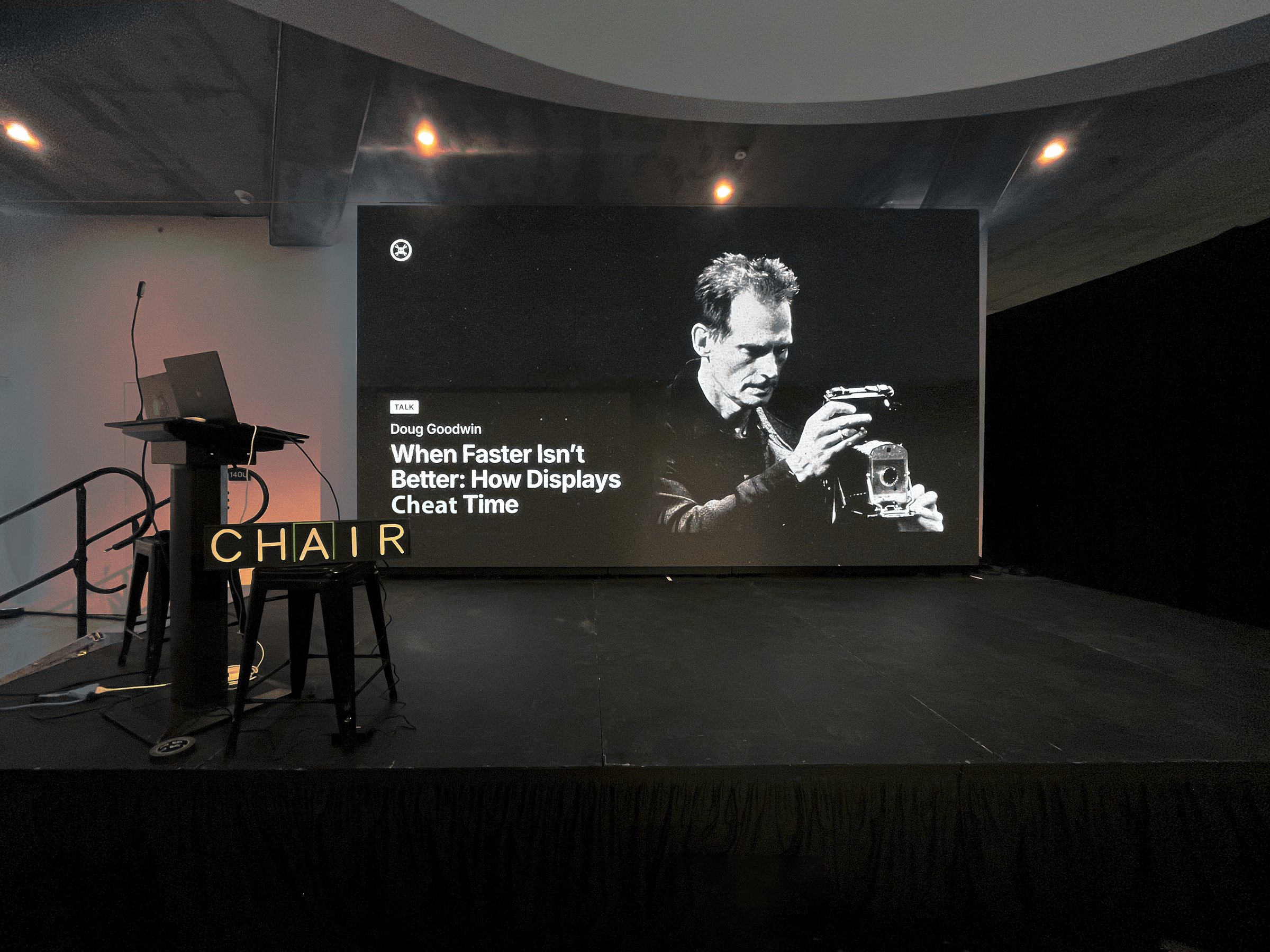
I opened in the dark. Rest your eyes in the center of the screen, I said, and I will flash a word. The room shouted back a chorus of CAR, with a few CHAIRs arguing. Then I ran the same five letters again, in order this time, and everyone read CHAIR. Nothing about the light changed except the sequence it arrived in. Your eyes received the same photons both times. Something in your head threw two letters away. That is the whole talk.
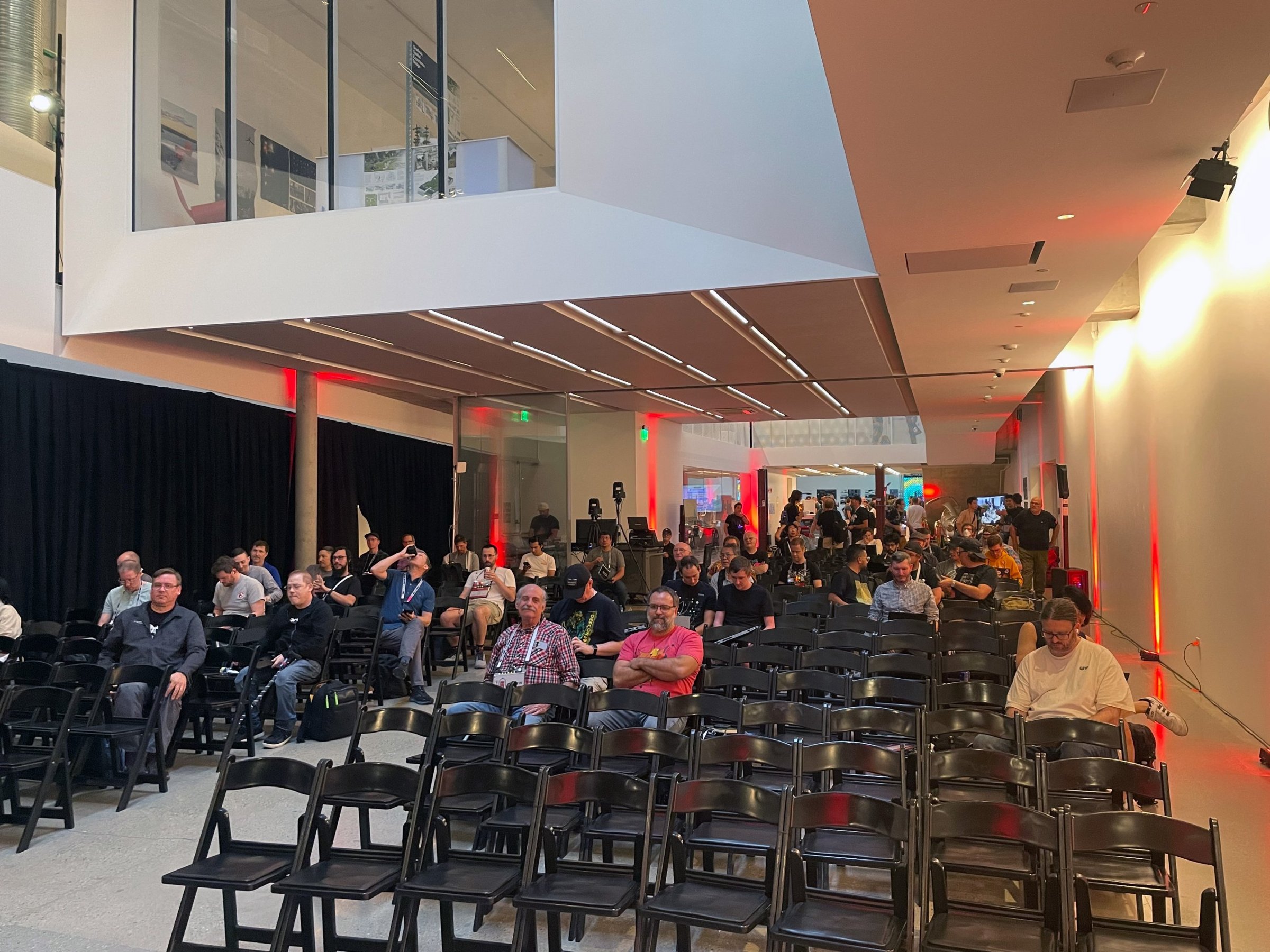
Mayzner found the sweet spot in 1968. Clap once: that impulse lasts about a tenth of a second. If a whole word arrives faster than that clap, you see all five letters at once. Slower than three claps and they step across like a sign. In between, the letters that arrived first get erased by the ones that came after, with peak erasure around 200 ms, about 40 ms a letter, which is what the room just watched. These are measurements, not a law. They slide with brightness and contrast.
If that went by too fast, here it is at quarter speed. The screen can show you this version; it cannot show you the one above.
Mark Mayzner was a cognitive psychologist, a PhD from NYU in 1956, then Bell Labs and Loyola. With Murray Tresselt he built the English letter-frequency tables that Peter Norvig later re-ran at Google. He was one of the first people to put a minicomputer in front of a human eye to find where seeing breaks down. My parents knew and admired him. Years after they died his name came back to me through Norvig's piece, so I wrote, and he phoned. He was in his eighties, and when he heard what I did for a living he proposed an experiment. He is 99 now.
In 2013 I rebuilt that experiment for his new iMac, a machine a thousand times faster than the one he had in 1968. The number keys set the time per letter in steps of 10 ms. And it worked. Sometimes. "This is very strange," he wrote. It was not strange, it was a bug, and it took me years to find because it was not in my code. It was in the glass. A screen refreshes 60 times a second: ask it for 5 ms of light and you get 16.7, a whole frame, starting whenever the next frame happens to begin. Letters straddle frame edges, two land on the same frame, some never clear the window at all. The projector behind me did the same thing all talk, so when a run read CHAIR where it should have read CAR, that was a frame edge and not anyone's eyes.
Mayzner's display had no frame rate at all: a DEC PDP-7 with 8K words of core, driving a Fairchild CRT whose phosphor went dark in microseconds, clocked by a crystal ticking 20,000 times a second. It could hold a letter for any multiple of 50 microseconds, switching it on and off two thousand times inside a single clap. My projector gets six goes. The PDP-7 did exactly one thing exactly when you asked it to. The iMac is a brilliant assistant who will absolutely get to it, right after forty other things, and then hands the result to a shutter that opens 60 times a second. It can count five milliseconds. It cannot promise five milliseconds of light. Precision is not speed. An ESP32, a 555 timer, a Nipkow disk: every one is a worse computer than that iMac, and every one of them can do it.
There is one result I could not picture until the box existed. Take a grid of a single letter and light it in groups, 20 ms on and 80 ms dark. Show two groups and the first pair vanishes. Now add more light, a third group lit last, and the first pair comes back. Adding light made something reappear. Mayzner called it disinhibition, and nobody fully knows why; Hartline and Ratliff saw the same shape in the eye of the horseshoe crab. I am happy to let it stay strange.
If the letters disappear, is the information gone too? Irwin Pollack asked that at Michigan in 1972 with a forced choice: rows of short lines instead of letters, one of them tilted. Did you see the line? No. Which line was different? That one, picked as accurately as when it was plainly visible, sometimes more so. Those are not the same question, and the visual system answers them differently. The information got in. The experience did not.
So: the same light twice, two different words. That is a problem of perception and a problem of instrumentation, and they are not the same problem. Something we called an improvement quietly changed which experiments we could still run, and it took an $80 analog scope and a box of LEDs to get one of them back. Which leaves the question I cannot answer, and neither can anyone else: how much of what reaches you do you ever get to see?
I wrote to Mayzner to ask about the past. He gave me an experiment to finish. Here is what he wrote in June 2013, about the half-working iMac version:
"Clearly, you have been able to produce what we hoped would appear. At our next session we will have much to discuss where we go next."
The slides, the interactive step-by-step versions of the experiments, and the Extras that did not fit in twenty minutes are all at hackaday.cairn.com. Point your phone at it and try HICAR yourself; it works best with the lights down.
Thanks to everyone at Hackaday for the invitation, and to the room for shouting out what they read.